Affichage des articles dont le libellé est BELDIVA 2012. Afficher tous les articles

mercredi 19 décembre 2012

Life in an extreme environment

Hello all,
Today (19th of January), I climbed up the Mt. Vikinghegda (2751m). It was so windy, cold and dry. It looked just like a desert. But I was very surprised by the resilience of living organisms!! I could find many algae and lichens under the surface of rocks 

                                           Picture of cryptoendolithic communities
 And at last, mosses were waiting for me !!  They were growing in the gaps between pebbles, at over 2100 m altitude. I believe that it should be the most severe and ultimate environment for mosses.
 This discovery made me very happy. This is a wonderful conclusion to my BELDIVA expedition to the Princess Elisabeth Station! Indeed, I will leave on the morning of the 21th December.

I would like to thank the Station personnel, the field guides and all the ones that made this expedition possible!

Best regards, Satoshi

mardi 18 décembre 2012

Snow White and Prasiola

Hi Annick,

One day, I've get a chance to visit Mt. Yukidori-toride, meaning
"Castle of snow petrels" in Japanese.  Large number of snow petrels
(pure white sea birds) are nested in the shade of rocks, and we can
find quite rich vegetation of green algae Prasiola, around their nest.
These algae are using the nutrients from the droppings of petrels. Indeed, the Petrels are transporting these nutrients from the sea to the inland nunatak.
They have to fly about 400 kms to get their food and come back to the nest, and sometimes feed a chick.
  
Snow White in Antarctica. A seabird, snow petrel. 
  
Green algae (Prasiola) around the nest of Snow petrel, Mt. Yukidori-toride.
 
Have a nice day, Satoshi Imura
 国立極地研究所
伊村 智

lundi 17 décembre 2012

Maintenance of Open Top Chambers

Dear all,
In addition to the exploration of the biodiversity of mosses and lichens, Satoshi Imura has also the important task of maintaining the Open Top Chambers that were installed in 2010 in four sites by Zorigto Namsaraev and Josef Elster.  We have placed microsensors to measure temperature and humidity in these OTC and in the control sites. They are programmed to take measurements during one year. However, after one year, their memory is full and they must be replaced. 
In November, Elie Verleyen went to the NIPR (Nippon Institute for Polar Research) in Tokyo and took all the necessary material. He showed Imura how to use the reader of the sensors, so that he could send us the data, and how to programme the new sensors for the next season.
In the blog, we already have explained the purpose of the Open Top Chambers:
 http://antarcticabelgium.blogspot.be/2010/02/simulation-de-changements-climatiques.html
Here is a picture of the Open Top Chamber on the Utsteinen Ridge. As the plexiglas is transparent, it is hard to see the plastic hexagone. We are always a bit worried that somebody would step on it by accident. Here, the OTC is snow-free. This was not the case of all OTC that Satoshi have visited, unfortunately. Indeed, it is impossible to locate the sensors when the OTC is covered by snow.


Cheers, Annick


vendredi 14 décembre 2012

The lichen and mosses

Hi Annick,

I want to show the main representants of the terrestrial vegetation in this region, mosses, lichens and algae.

Fresh green moss under the sand, Utsteinen.
 
 Blackish fruticose lichen (Usnea), Utsteinen.
 
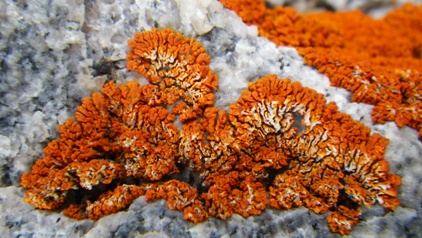
Orange lichen on the rock, Mt. Yukidori-toride. 
 
 
Satoshi Imura


mercredi 12 décembre 2012

Rescue training

Dear all,
On arrival at the station, all scientists have received a training to learn to drive skidoos, but also to learn how to rescue people who have fallen in a crevasse, or if the person is in danger. This is important for the researchers who are going in the field. 

Satoshi is sending us a 
  Fantastic view from the bottom of large crevasse!!

Cheers, Annick

lundi 10 décembre 2012

First message from Satoshi Imura

Hello all,
Our colleague Satoshi is enthusiastic about the terrestrial diversity around the station Princess Elisabeth! Cheers, Annick
 
 
Hi Annick,

Utsteinen area should have the most rich terrestrial vegetation in this region.  With the field guide and other colleagues in PES, I could go out to search for mosses and lichens almost every day.  I want to say thanks for all the staffs in the station. 
Have a nice day, Imura 

mercredi 5 décembre 2012

Our colleague Satoshi Imura

Hello all,
In December 2012, the BELDIVA partners have asked to a Japanese colleague to participate to the campaign in the Princess Elisabeth station.
Satoshi IMURA is a Biologist working at the National Institute of Polar Research, Japan
There is a description of his research at :  http://www.nipr.ac.jp/soken-e/teacher/imura_t05.html
Here, he is presenting himself:
"I'm interested in the diversity and reproduction of mosses in Antarctica, one of the extreme environment in the world.  I want to clarify the diversity of mosses in the Princess Elizabeth Station area."
 
He will tell us about this expedition, in the next days,
Cheers, Annick Wilmotte