
If you wish to see the scientists in action, there is a video on the website of the Belgian Station:
http://www.antarcticstation.org/index.php?s=no&puid=435&uid=443&pg=1&category=11
Affichage des articles dont le libellé est BELDIVA 2010. Afficher tous les articles
Affichage des articles dont le libellé est BELDIVA 2010. Afficher tous les articles
jeudi 8 avril 2010
mardi 9 mars 2010
Impressions from Josef Elster
Dear colleagues, and friends,
Annick has asked me to write my personal observations during our Princess Elisabeth and Schirmacher Oasis stays. When I was in Antarctica, we have been so busy for most of time that it was quite difficult to do this chronicle. Finally, we are at home now, and I will try to give you a small account of our expedition. I would like to thank Annick who has invited me for the expedition, and BELSPO who has financed my participation to BELDIVA, as well as Zorigto, Elie and Steve with whom I have been working.
 The team in action
I also appreciated the friendship and collegiality of all members of the Belgian Antarctic expedition, mainly Alain and Gigi. I really appreciated it. I have learned a lot. Science, management and technology of the Belgian Antarctic activities are quite unique. I have been several times doing research in the Arctic and coastal Antarctica, but this was my first experience in a really continental place. I have brought home a lot of experiences which I will use in my future Arctic and Antarctic research.
I am also very glad that I could work with Zorigto on all the experiments. I am very interested by the experiment with the OTC, which simulates a climatic warming.

In addition, I also appreciate that we decided to measure the photosynthetic activity of soil crusts by fluorometry.

I believe that the combination of fluorimetry together with the molecular analyses of soil crust and the estimation of cyanobacteria and microalgae cell numbers and biovolumes will help us to understand the reaction of microbial communities to climate change. The study of cryptogamic soil crusts under a slight warming in continental Antarctica is really important.
The cryoconite study that we have performed was quite impressive. We have visited a lot of localities, where we have drilled cryoconite sediments from various depths, cryoconite sizes, etc.


I am really wondering how many strains we will be able to isolate and if the single strains will differ from each other? At this moment, we can only speculate that cyanobacteria occurring in cryoconite sediments can originate from different geographical areas and could be stored in ice for different time periods (from one year to several thousand years).
The experiment of air pumping and the collection of dust transported by air for microbial DNA analyses is also very interesting.
 Here, Zorigto is on the top of the shelter and installs the pump outlet.
I am really interested in these results. A few years ago, we have shown that there is a special group of pigmented bacteria which is transported at very large intercontinental distances. Special pigments probably protect these cells against UV radiation.
Finally, both our laboratories are interested in the origin of the Antarctic cyanobacteria. We know from our previous studies that a large part of cyanobacterial communities differ from their counterparts from other parts of world. In addition, we have been working for several seasons in the northern part of Antarctic Peninsula (South Shetlands, James Ross Island). How do these cyanobacteria differ from each other? There are many questions we would like to answer. I collected many samples from various habitats, 36 samples from the Princess Elisabeth area, and 28 from Schirmacher Oasis
 Black crust near the PE station
 Leptolyngbya antarctica, Schirmacher Oasis
 Soil crust in Schirmacher Oasis
 Endolithic community, Schirmacher Oasis
We will isolate cyanobacterial strains from these samples in my laboratory and together with my Belgian colleagues, we will perform a collaborative study of their diversity. A good thing is also that we benefit this year from a bilateral cooperation between Wallonie-Bruxelles International (WBI) and the Czech Republic, to visit each other.
Best regards, Josef
Annick has asked me to write my personal observations during our Princess Elisabeth and Schirmacher Oasis stays. When I was in Antarctica, we have been so busy for most of time that it was quite difficult to do this chronicle. Finally, we are at home now, and I will try to give you a small account of our expedition. I would like to thank Annick who has invited me for the expedition, and BELSPO who has financed my participation to BELDIVA, as well as Zorigto, Elie and Steve with whom I have been working.
 The team in action
I also appreciated the friendship and collegiality of all members of the Belgian Antarctic expedition, mainly Alain and Gigi. I really appreciated it. I have learned a lot. Science, management and technology of the Belgian Antarctic activities are quite unique. I have been several times doing research in the Arctic and coastal Antarctica, but this was my first experience in a really continental place. I have brought home a lot of experiences which I will use in my future Arctic and Antarctic research.
I am also very glad that I could work with Zorigto on all the experiments. I am very interested by the experiment with the OTC, which simulates a climatic warming.

In addition, I also appreciate that we decided to measure the photosynthetic activity of soil crusts by fluorometry.

I believe that the combination of fluorimetry together with the molecular analyses of soil crust and the estimation of cyanobacteria and microalgae cell numbers and biovolumes will help us to understand the reaction of microbial communities to climate change. The study of cryptogamic soil crusts under a slight warming in continental Antarctica is really important.
The cryoconite study that we have performed was quite impressive. We have visited a lot of localities, where we have drilled cryoconite sediments from various depths, cryoconite sizes, etc.


I am really wondering how many strains we will be able to isolate and if the single strains will differ from each other? At this moment, we can only speculate that cyanobacteria occurring in cryoconite sediments can originate from different geographical areas and could be stored in ice for different time periods (from one year to several thousand years).
The experiment of air pumping and the collection of dust transported by air for microbial DNA analyses is also very interesting.
 Here, Zorigto is on the top of the shelter and installs the pump outlet.
I am really interested in these results. A few years ago, we have shown that there is a special group of pigmented bacteria which is transported at very large intercontinental distances. Special pigments probably protect these cells against UV radiation.
Finally, both our laboratories are interested in the origin of the Antarctic cyanobacteria. We know from our previous studies that a large part of cyanobacterial communities differ from their counterparts from other parts of world. In addition, we have been working for several seasons in the northern part of Antarctic Peninsula (South Shetlands, James Ross Island). How do these cyanobacteria differ from each other? There are many questions we would like to answer. I collected many samples from various habitats, 36 samples from the Princess Elisabeth area, and 28 from Schirmacher Oasis
 Black crust near the PE station
 Leptolyngbya antarctica, Schirmacher Oasis
 Soil crust in Schirmacher Oasis
 Endolithic community, Schirmacher Oasis
We will isolate cyanobacterial strains from these samples in my laboratory and together with my Belgian colleagues, we will perform a collaborative study of their diversity. A good thing is also that we benefit this year from a bilateral cooperation between Wallonie-Bruxelles International (WBI) and the Czech Republic, to visit each other.
Best regards, Josef
mardi 2 mars 2010
Last email from Schirmacher Oasis and trip to Cape Town
Thursday 12 February
Dear all,
Here is my second and last email from the Schirmacher Oasis. When the wind speed has decreased enough, we have started to go the glacier near the Oasis, and we continued to drill cryoconites. The glacier bordering the Oasis, where you can see a lateral view of the cryoconites
It is a kind of 'addiction': once you start drilling, you cannot stop anymore;).
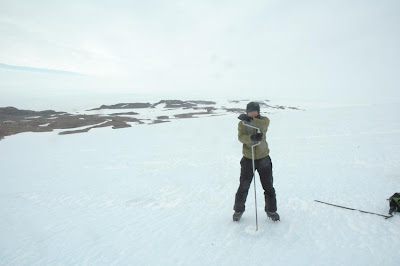
In contrast to the cryoconites in the Sor Rondane Mountains, here, the ice lids were much softer and to drill them was a real pleasure. Not more than 5-10 minutes of work. Moreover, the quantity of water, sediments and biofilms was also higher here!

Then, I started to understand why Andy Hodson had advised us to drill a dozen cryoconites, at minimum. He probably was used to 'normal' cryoconites, whereas the permanently cold conditions near the Belgian base were quite extreme and resulted in cryoconite holes with a deeper ice lid and less good conditions for the microorganisms.
The size of the cryoconites in the Schirmacher Oasis is in general smaller than in the Sör Rondane Mountains. This is probably due to the different origins of the cryoconites. In the Mountains, a large fraction of the cryoconites originate from stones and boulders falling from the rocks. There is not so much dust there. In contrast, on the glacier above the Schirmacher Oasis, they can originate only from the dust transported by winds from the Oasis.
The window of good weather that was predicted by the meteorologists was relatively short and the Ilyuchin Il-76 could arrive on each of the days. We were informed that, at any moment, we could be asked to go with all our luggage to the Novo Runway. The only problem was with the feeder flights with the smaller Basslers. Contrary to the giant IL-76, the Basslers were more sensitive to high wind speeds.
 Indeed, it was quite windy on the Novo Runway when we arrived there on the 11th. Our friends from the Princess Elisabeth, who had to fly back with us to Cape Town, were lucky to be in time on the Novo Runway. However, a big group of Germans from the Neumayer station could not make it. The weather on Novo was too harsh. ALCI decided to change the route. Instead of a direct flight to Cape Town, we went first to Troll station. There, we picked the German team and only after that, we left to Cape Town. We landed safely, and on the 14th, we took a flight to Frankfurt. Josef left there, to go back to the Czech Republic. I arrived in Belgium on the 15th.
The expedition is not finished until all the samples have arrived in the laboratory to be analysed, but for us, the field work is done.
After all these days in Antarctica I would like to thank the personel of the stations "Princess Elisabeth", "Novolazarevskaya", Novo Runway, "Maitri" and "Troll" for their hospitality.
Special thanks go to Alain Hubert, Gigi, Rene Robert, Alain Trullemans, Sanne Bosteels, Koen Verschraegen, Jurgen Van Obberghen, Olivier Diez, Kristof Soete, David Gladsteen, Pierre Soete, Sylvain Doucement, Johan Berte, Dominique Corbisier, Sven Kerremans, Karel Moerman, David Rigotti and Irina Gorodetskaya. Sorry if I forgot to mention somebody. It means that I didn't find your name in the list with e-mails.
Our work and life on Novolazarevskaya would be much more difficult without the help of Valery Lukin, Viktor Venderovich, Dmitry Fedorov,Mikhail Shorkin, Maxim Chistyakov, Alexander, Ivan, Yaroslav and Nadya. Our transportation would be impossible without efforts of ALCI members: Alexey Turchin, Oleg Sakharov, Vasily Kaliazin, Vladimir Kiryanov, Vladimir Baranov. Last but not least, the pilots of Basslers and IL-76, led by Ruben Esayan.
Many people in Belgium supported us before and during expedition: Maaike Vancauwenberghe (BELSPO), all members of the laboratory of Dr Annick Wilmotte, Alexander Mangold, Andy Hodson, Willy Maenhaut, Laurence Vanlede.
The work of the BELDIVA team was supported by the Belgian Federal Science Policy Office. Zorigto Namsaraev is supported by a post-doctoral fellowship from the Fonds de la Recherche Scientifique - FNRS.
Cheers, Zorigto
Dear all,
Here is my second and last email from the Schirmacher Oasis. When the wind speed has decreased enough, we have started to go the glacier near the Oasis, and we continued to drill cryoconites.
 The glacier bordering the Oasis, where you can see a lateral view of the cryoconites
It is a kind of 'addiction': once you start drilling, you cannot stop anymore;).

In contrast to the cryoconites in the Sor Rondane Mountains, here, the ice lids were much softer and to drill them was a real pleasure. Not more than 5-10 minutes of work. Moreover, the quantity of water, sediments and biofilms was also higher here!

Then, I started to understand why Andy Hodson had advised us to drill a dozen cryoconites, at minimum. He probably was used to 'normal' cryoconites, whereas the permanently cold conditions near the Belgian base were quite extreme and resulted in cryoconite holes with a deeper ice lid and less good conditions for the microorganisms.
The size of the cryoconites in the Schirmacher Oasis is in general smaller than in the Sör Rondane Mountains. This is probably due to the different origins of the cryoconites. In the Mountains, a large fraction of the cryoconites originate from stones and boulders falling from the rocks. There is not so much dust there. In contrast, on the glacier above the Schirmacher Oasis, they can originate only from the dust transported by winds from the Oasis.
The window of good weather that was predicted by the meteorologists was relatively short and the Ilyuchin Il-76 could arrive on each of the days. We were informed that, at any moment, we could be asked to go with all our luggage to the Novo Runway. The only problem was with the feeder flights with the smaller Basslers. Contrary to the giant IL-76, the Basslers were more sensitive to high wind speeds.
 Indeed, it was quite windy on the Novo Runway when we arrived there on the 11th. Our friends from the Princess Elisabeth, who had to fly back with us to Cape Town, were lucky to be in time on the Novo Runway. However, a big group of Germans from the Neumayer station could not make it. The weather on Novo was too harsh. ALCI decided to change the route. Instead of a direct flight to Cape Town, we went first to Troll station. There, we picked the German team and only after that, we left to Cape Town. We landed safely, and on the 14th, we took a flight to Frankfurt. Josef left there, to go back to the Czech Republic. I arrived in Belgium on the 15th.
The expedition is not finished until all the samples have arrived in the laboratory to be analysed, but for us, the field work is done.
After all these days in Antarctica I would like to thank the personel of the stations "Princess Elisabeth", "Novolazarevskaya", Novo Runway, "Maitri" and "Troll" for their hospitality.
Special thanks go to Alain Hubert, Gigi, Rene Robert, Alain Trullemans, Sanne Bosteels, Koen Verschraegen, Jurgen Van Obberghen, Olivier Diez, Kristof Soete, David Gladsteen, Pierre Soete, Sylvain Doucement, Johan Berte, Dominique Corbisier, Sven Kerremans, Karel Moerman, David Rigotti and Irina Gorodetskaya. Sorry if I forgot to mention somebody. It means that I didn't find your name in the list with e-mails.
Our work and life on Novolazarevskaya would be much more difficult without the help of Valery Lukin, Viktor Venderovich, Dmitry Fedorov,Mikhail Shorkin, Maxim Chistyakov, Alexander, Ivan, Yaroslav and Nadya. Our transportation would be impossible without efforts of ALCI members: Alexey Turchin, Oleg Sakharov, Vasily Kaliazin, Vladimir Kiryanov, Vladimir Baranov. Last but not least, the pilots of Basslers and IL-76, led by Ruben Esayan.
Many people in Belgium supported us before and during expedition: Maaike Vancauwenberghe (BELSPO), all members of the laboratory of Dr Annick Wilmotte, Alexander Mangold, Andy Hodson, Willy Maenhaut, Laurence Vanlede.
The work of the BELDIVA team was supported by the Belgian Federal Science Policy Office. Zorigto Namsaraev is supported by a post-doctoral fellowship from the Fonds de la Recherche Scientifique - FNRS.
Cheers, Zorigto
lundi 8 février 2010
Work in Schirmacher Oasis
Dear all,
Finally, the weather has improved enough, so that Josef and myself could start our sampling expeditions and Elie and Steve could start the coring of lake sediments.
 We have sampled near Lake Melkoye, spied by a curious skua.
 The skuas are very daring and if you turn your head, they can steal things in your backpack, a bit like the magpies. The Commander told us that he has found in their nest, metallic pieces that they just had stolen from him! So, beware!
 We have observed much more 'green flakes' and biofilms in this Oasis than at the Belgian Station. The conditions are clearly milder and better for the development of the microorganisms. In addition, the abundance of the mosses is striking. It seems that they occupy the terrestrial biotopes as soon as there is a bit of humidity.
 On the stones that are under water, we can see a thick biofilm, with a quite orange colour, a bit hairy-like.
 The hardest work was still to come. In order to core, Steve and Elie needed a lot of heavy equipment. As the Oasis is ice-free, there was no possibility to go with a skidoo and a sledge to the lakes. Everything had to be transported in the backpacks. Eventually, Steve and Elie lured us into helping to transport their material in exchange for a honorary membership of the Belgian Society of Paleolimnology! We could not resist such a great honour, and sweated happily for this reward!
Very tired, I wish you a good night! Zorigto
Finally, the weather has improved enough, so that Josef and myself could start our sampling expeditions and Elie and Steve could start the coring of lake sediments.
 We have sampled near Lake Melkoye, spied by a curious skua.
  The skuas are very daring and if you turn your head, they can steal things in your backpack, a bit like the magpies. The Commander told us that he has found in their nest, metallic pieces that they just had stolen from him! So, beware!
 We have observed much more 'green flakes' and biofilms in this Oasis than at the Belgian Station. The conditions are clearly milder and better for the development of the microorganisms. In addition, the abundance of the mosses is striking. It seems that they occupy the terrestrial biotopes as soon as there is a bit of humidity.
 On the stones that are under water, we can see a thick biofilm, with a quite orange colour, a bit hairy-like.
 The hardest work was still to come. In order to core, Steve and Elie needed a lot of heavy equipment. As the Oasis is ice-free, there was no possibility to go with a skidoo and a sledge to the lakes. Everything had to be transported in the backpacks. Eventually, Steve and Elie lured us into helping to transport their material in exchange for a honorary membership of the Belgian Society of Paleolimnology! We could not resist such a great honour, and sweated happily for this reward!
Very tired, I wish you a good night! Zorigto
jeudi 4 février 2010
Arrival at the Schirmacher Oasis
Wednesday, 3 February 2010
Hello again,
We have arrived on the last day of January to the Novo airstrip, after saying good-bye to the Princess Elisabeth. Everything was well organised. We were first transported from the plane with big, fancy Toyota. People told me that they had been used for a traverse to the South Pole last year. Now, they serve as transit vehicles.
 But the best was to come..... an orange transformed Russian tank!
We arrived smoothly to the Station of Novolazarevskaya, made of prefab buildings. I notice that the Belgian flag is floating there, as it is a custom to display the flags of the nationals who are hosted by Antarctic stations.

We are lodging in a guest house of ALCI, it is quite cosy. We eat with all other people at the mess of the station, and we can enjoy some sporting facilities, like the local billiard.

We have met with the Director of Russian Antarctic Expedition, V.V. Lukin and thanked him for his support and the hospitality of the Station. He was there and, in fact, he took the same flight as Francois who was also flying with us from PES. I did a presentation about our project and about the Princess Elisabeth station. Everybody was very interested in their closest neighbour from the eastern side (410 km).
People are very friendly and hospitable. As we discover this new place, the scientists present help us with the orientation and the choice of the right spots for analysis.
 Elie and myself speaking with a Russian scientist, Dimitry Fedorov
Unfortunately, at present, we cannot use their advices because the wind is about 20 m/s (72 km/h) and will not decrease soon. It's too windy even for the sampling of lithophytic cyanobacterial crusts which are very abundant here. Any sampling on the ice sheet or coring from the boat is, of course, absolutely impossible. The only experiment that we could start is air filtration. Fortunately, we have transported with us the air pump from the Princess Elisabeth. Moreover, Denis Lombardi who arrived with the same Bassler with which we left, has brought the anemometer that Nicole van Lipzig has given to him. We have installed the vacuum pump on the meteostation in the Eastern part of the Oasis. The wind is coming directly from the East. In fact for such expeditions, it is good to have 2 types of experiments: one for good weather and one for bad conditions. So at least, half of experiments will be done!
Waiting for better weather, we decided to pay a visit to the neighboring Indian station, Maitri. From there, I send you this blog!
 Elie with the Maitri station Commander
Cheers, hopefully with some pictures of the Oasis! Zorigto
Hello again,
We have arrived on the last day of January to the Novo airstrip, after saying good-bye to the Princess Elisabeth. Everything was well organised. We were first transported from the plane with big, fancy Toyota. People told me that they had been used for a traverse to the South Pole last year. Now, they serve as transit vehicles.
 But the best was to come..... an orange transformed Russian tank!
 We arrived smoothly to the Station of Novolazarevskaya, made of prefab buildings. I notice that the Belgian flag is floating there, as it is a custom to display the flags of the nationals who are hosted by Antarctic stations.

We are lodging in a guest house of ALCI, it is quite cosy. We eat with all other people at the mess of the station, and we can enjoy some sporting facilities, like the local billiard.

We have met with the Director of Russian Antarctic Expedition, V.V. Lukin and thanked him for his support and the hospitality of the Station. He was there and, in fact, he took the same flight as Francois who was also flying with us from PES. I did a presentation about our project and about the Princess Elisabeth station. Everybody was very interested in their closest neighbour from the eastern side (410 km).
People are very friendly and hospitable. As we discover this new place, the scientists present help us with the orientation and the choice of the right spots for analysis.
 Elie and myself speaking with a Russian scientist, Dimitry Fedorov
Unfortunately, at present, we cannot use their advices because the wind is about 20 m/s (72 km/h) and will not decrease soon. It's too windy even for the sampling of lithophytic cyanobacterial crusts which are very abundant here. Any sampling on the ice sheet or coring from the boat is, of course, absolutely impossible. The only experiment that we could start is air filtration. Fortunately, we have transported with us the air pump from the Princess Elisabeth. Moreover, Denis Lombardi who arrived with the same Bassler with which we left, has brought the anemometer that Nicole van Lipzig has given to him. We have installed the vacuum pump on the meteostation in the Eastern part of the Oasis. The wind is coming directly from the East. In fact for such expeditions, it is good to have 2 types of experiments: one for good weather and one for bad conditions. So at least, half of experiments will be done!
Waiting for better weather, we decided to pay a visit to the neighboring Indian station, Maitri. From there, I send you this blog!
 Elie with the Maitri station Commander
Cheers, hopefully with some pictures of the Oasis! Zorigto
lundi 1 février 2010
Climatic changes simulation and « Open Top Chambers »
Hello,
Maybe that you wonder what are the Open Top Chambers, that Zorigto is placing at different locations in the region of the Station?
For the projects ITEX (http://www.cevl.msu.edu/ael/projects/tempmanip.html) and Tarantella (http://www.ipy.org/projects/item/410-tarantella-terrestrial-ecosystems-in-and-Arctic-Antarctic), the Open Top Chambers (OTC) were developed to simulate the impact of climate change on terrestrial ecosystems in the short and long term in polar regions (Arctic and Antarctica). OTC are small greenhouses that increase the temperature (average of 2 ° C) and humidity, and decrease the wind strength.
The establishment of a long-term experiment in polar regions request a simple, strong experimental procedure, that does not depend on a energy source because of harsh climatic conditions. For example, at Signy Island (Sub-Antarctic Island), a OTC was blown away by the wind. The choice of the structure and especially its fixation on the rock surface are very important because, during the austral winter, the station is closed and nobody can repair damages.
Thus, the selected OTCs have the form of a hexagonal pyramid with an open top allowing exchanges with the outside and a limited temperature increase.
Microprobes measuring temperature and humidity are placed in these structures in order to monitor these parameters during time in the OTC. Controls sites are also selected with similar initial conditions to assess the modifications due to natural environmental changes. This allows to distinguish between natural variations and those due to conditions present in the OTC. Annual monitoring of diversity and coverage of communities will be carried out.
Our OTC have been built by the technicians of the General Workshop of Mechanics of the Faculty of Sciences, Michel Leroy et Michel Colin, that we thank for their helpfulness and efficiency!
 We have ordered the screws, the ropes to anchor them, and other accessories. Here, you see Zorigto and myself testing the first prototype of OTC built at the Workshop.A real Légo!!
 Here, you see Zorigto placing two OTCs on the Teltet nunatak.
 While building them, we were dreaming about the possible effects of the OTCs on the Antarctic biodiversity!
Marie-José Mano (PhD student)
Maybe that you wonder what are the Open Top Chambers, that Zorigto is placing at different locations in the region of the Station?
For the projects ITEX (http://www.cevl.msu.edu/ael/projects/tempmanip.html) and Tarantella (http://www.ipy.org/projects/item/410-tarantella-terrestrial-ecosystems-in-and-Arctic-Antarctic), the Open Top Chambers (OTC) were developed to simulate the impact of climate change on terrestrial ecosystems in the short and long term in polar regions (Arctic and Antarctica). OTC are small greenhouses that increase the temperature (average of 2 ° C) and humidity, and decrease the wind strength.
The establishment of a long-term experiment in polar regions request a simple, strong experimental procedure, that does not depend on a energy source because of harsh climatic conditions. For example, at Signy Island (Sub-Antarctic Island), a OTC was blown away by the wind. The choice of the structure and especially its fixation on the rock surface are very important because, during the austral winter, the station is closed and nobody can repair damages.
Thus, the selected OTCs have the form of a hexagonal pyramid with an open top allowing exchanges with the outside and a limited temperature increase.
Microprobes measuring temperature and humidity are placed in these structures in order to monitor these parameters during time in the OTC. Controls sites are also selected with similar initial conditions to assess the modifications due to natural environmental changes. This allows to distinguish between natural variations and those due to conditions present in the OTC. Annual monitoring of diversity and coverage of communities will be carried out.
Our OTC have been built by the technicians of the General Workshop of Mechanics of the Faculty of Sciences, Michel Leroy et Michel Colin, that we thank for their helpfulness and efficiency!

 Here, you see Zorigto placing two OTCs on the Teltet nunatak.
  While building them, we were dreaming about the possible effects of the OTCs on the Antarctic biodiversity!
Marie-José Mano (PhD student)
Simulation de changements climatiques et les « Open Top Chambers »
Bonjour, au cas où vous vous demandez ce que sont ces 'Open Top Chambers' que Zorigto a placé dans différents sites près de la Station, voici une description.
Dans le cadre des projets ITEX (http://www.cevl.msu.edu/ael/projects/tempmanip.html) et Tarantella (http://www.ipy.org/projects/item/410-tarantella-terrestrial-ecosystems-in-arctic-and-antarctic), les « Open Top Chambers » (OTC) ont été développées pour simuler l'impact des changements climatiques sur les écosystèmes terrestres à court et long terme en région polaire (Arctique et Antarctique). Les OTC sont des petites serres qui augmentent la température (en moyenne de 2°C) et l'humidité, et diminuent la force du vent.
La mise en place d’une expérience à long terme en région polaire demande un procédé expérimental simple,très résistant et ne dépendant pas d’une source d’énergie à cause des conditions climatiques difficiles. Par exemple, à Signy Island (Ile Sub-Antarctique), une OTC a été emportée par le vent. Le choix de la structure et surtout de sa fixation, ici sur une surface rocheuse, est très important car durant l’hiver austral, la station est fermée et personne ne pourra réparer ce qui aura été endommagé.
Ainsi, les OTC que nous avons sélectionnées pour BELDIVA ont une forme de pyramide hexagonale avec une ouverture au sommet permettant des échanges avec l'extérieur ainsi qu'une augmentation de température moins forte.
Des microsondes mesurant la température et l’humidité sont placées dans ces structures de façon à suivre l’évolution de ces paramètres au cours du temps dans les OTC. Des sites contrôles sont aussi sélectionnés, présentant des conditions initiales similaires pour pouvoir évaluer les modifications dûes aux changements environnementaux naturels. Ceci permettra de faire la distinction entre variations naturelles et celles dûes aux conditions présentes dans les OTC. Un suivi annuel de la diversité et de la couverture des communautés sera effectué.
Nos OTC ont été réalisées par les techniciens de l'Atelier Général de Mécanique de la Faculté des Sciences, Michel Leroy et Michel Colin, que nous remercions pour leur serviabilité et efficacité!
Nous avons commandé les vis, les filins pour les ancrer, et autres accessoires. Ici, vous nous voyez, Zorigto et moi-même, en train de tester le premier prototype des OTC construites à l'Atelier. Un vrai Légo!!
 Voici le résultat: Zorigto installant deux OTCs sur le nunatak de Teltet.
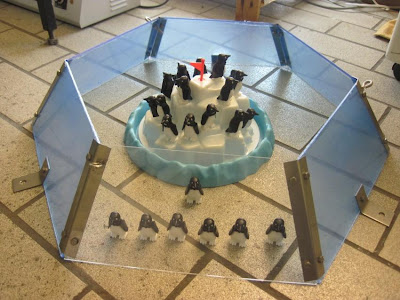 Tout en la construisant, nous avons rêvé aux effets possibles de l'OTC sur la biodiversité Antarctique!
Marie-José Mano (doctorante)
Dans le cadre des projets ITEX (http://www.cevl.msu.edu/ael/projects/tempmanip.html) et Tarantella (http://www.ipy.org/projects/item/410-tarantella-terrestrial-ecosystems-in-arctic-and-antarctic), les « Open Top Chambers » (OTC) ont été développées pour simuler l'impact des changements climatiques sur les écosystèmes terrestres à court et long terme en région polaire (Arctique et Antarctique). Les OTC sont des petites serres qui augmentent la température (en moyenne de 2°C) et l'humidité, et diminuent la force du vent.
La mise en place d’une expérience à long terme en région polaire demande un procédé expérimental simple,très résistant et ne dépendant pas d’une source d’énergie à cause des conditions climatiques difficiles. Par exemple, à Signy Island (Ile Sub-Antarctique), une OTC a été emportée par le vent. Le choix de la structure et surtout de sa fixation, ici sur une surface rocheuse, est très important car durant l’hiver austral, la station est fermée et personne ne pourra réparer ce qui aura été endommagé.
Ainsi, les OTC que nous avons sélectionnées pour BELDIVA ont une forme de pyramide hexagonale avec une ouverture au sommet permettant des échanges avec l'extérieur ainsi qu'une augmentation de température moins forte.
Des microsondes mesurant la température et l’humidité sont placées dans ces structures de façon à suivre l’évolution de ces paramètres au cours du temps dans les OTC. Des sites contrôles sont aussi sélectionnés, présentant des conditions initiales similaires pour pouvoir évaluer les modifications dûes aux changements environnementaux naturels. Ceci permettra de faire la distinction entre variations naturelles et celles dûes aux conditions présentes dans les OTC. Un suivi annuel de la diversité et de la couverture des communautés sera effectué.
Nos OTC ont été réalisées par les techniciens de l'Atelier Général de Mécanique de la Faculté des Sciences, Michel Leroy et Michel Colin, que nous remercions pour leur serviabilité et efficacité!
 Voici le résultat: Zorigto installant deux OTCs sur le nunatak de Teltet.
 Tout en la construisant, nous avons rêvé aux effets possibles de l'OTC sur la biodiversité Antarctique!
Marie-José Mano (doctorante)
jeudi 28 janvier 2010
27 January, Wednesday
Hello,
Today we went to Pingvinane and Tanngarden. We collected the data from the loggers placed in the granite outcrop on the Northern side of Tanngarden (couple of km to the SW from Pingvinane) and from Pingvinane nunatak. The highest temperature outside of the OTC was observed in Tanngarden and it was +17 C!!. The highest temperature inside the OTC was also observed in the same site. It seems that the windskoop at this site is the most interesting place from a biological point of view.
Interestingly, the mean temperature in Teltet was higher than in Tanngarden, despite the fact that we cannot see biofilms. Thus, the absence of visible life is not due to the meteorological conditions, but some other factors, maybe linked to the rock structure and stability? In addition, I collected some biomass from the OTCs and the control sites outside.
Moreover, we have collected dust from the aerosol traps (pancake forms) in Tanngarden and Teltet.
 Back at the station for a snowbath!
 Karl, Olivier and Sylvain working on the electric installation of the SSS, with Koen and John (not on the picture).
At the station, Johan and the guys have done their best to equip the Southern Scientific Shelter with electricity and drill 2 small holes to insert the tubing of the pump. As the wind is stable (SE or E), we have started the filtration of air. Tomorrow, we will drill again into the cryoconites.
Today we went to Pingvinane and Tanngarden. We collected the data from the loggers placed in the granite outcrop on the Northern side of Tanngarden (couple of km to the SW from Pingvinane) and from Pingvinane nunatak. The highest temperature outside of the OTC was observed in Tanngarden and it was +17 C!!. The highest temperature inside the OTC was also observed in the same site. It seems that the windskoop at this site is the most interesting place from a biological point of view.
Interestingly, the mean temperature in Teltet was higher than in Tanngarden, despite the fact that we cannot see biofilms. Thus, the absence of visible life is not due to the meteorological conditions, but some other factors, maybe linked to the rock structure and stability? In addition, I collected some biomass from the OTCs and the control sites outside.
Moreover, we have collected dust from the aerosol traps (pancake forms) in Tanngarden and Teltet.
 Back at the station for a snowbath!
 Karl, Olivier and Sylvain working on the electric installation of the SSS, with Koen and John (not on the picture).
At the station, Johan and the guys have done their best to equip the Southern Scientific Shelter with electricity and drill 2 small holes to insert the tubing of the pump. As the wind is stable (SE or E), we have started the filtration of air. Tomorrow, we will drill again into the cryoconites.


19-24 January
Hello,
The last week has been so busy that it was difficult to find time and energy to write the news. Now, I am trying to make a small synthesis of our activities.
We have installed all the OTCs with their microsensors and data loggers.
 The OTCs on the Teltet nunatak
 Zorigto reading the data loggers on the Teltet nunatak
We have visited the Vengen ridge, the Teltet nunatak, the small "japanese" lakes near Kanino-tume Peak near the Ketelersbreen glacier, the tertiary moraine at the beginning of the ‘dry valley’ between Ketelersbreen and the Southern slope of Vikinghoda massif.
 View from the Vengen moraine in the direction of the Kanino-tume peak and the Ketelersbreen glacier (note of Annick: this peak is really impressive. Last year, when we went there with the Japanese geologists, the weather was grey and foggy, and when discovering the peak, it looked like a middle-age fortress garding the passage to the valley, with something frightening about it)
 In the Vikinghoda massif, we have found a quartz block on a ridge, measuring 5x5 meters approximately. If we look at the place where the block is entering into a thin layer of sand, there is a green layer of photosynthetic organisms.
 The Petrelnutten windskoop
We have visited all the granite oucrops in this area until Petrellnuten (last nunatak behind Pingvinane).
 When we come back, there is always a small emotion to see the characteristic shape of Utsteinen raising above the ice.
It appeared that the diversity of algae in Ketelersbreen was only due to the fertilisation by birds living on Kanino-tume Peak. In fact, this area is not good for further studies. We didn't installed OTC there because there were no biofilms, except for the cryptoendolithes.
There are clear differences between the gneiss ridges with nonstable moraines and low number of biofilms on one side and between the granite nunataks with stable surfaces and a high number of biofilms on the other side.
Probably, the distribution of biofilms can be explained by the stability of substrates (granite vs. gneiss) and the low growth rate of biofilms. Except granite, there are 2 other types of rocks which are stable. It's Tonalite and Cyanite, but their outcrops are quite far and it is not possible to go there this year.
We measure currently the daily cycles of fluorescence measurements on the ridge. As they were difficult to interpret, I have sent them to Bart Ghysels and Fabrice Franck who study photosynthesis at the University of Liège. As we will have all meteorological data that was recorded by the meteostation here, we'll be able to compare them with temperature/humidity that we measure on the surface of rocks.
Cheers, Zorigto
The last week has been so busy that it was difficult to find time and energy to write the news. Now, I am trying to make a small synthesis of our activities.
We have installed all the OTCs with their microsensors and data loggers.
 The OTCs on the Teltet nunatak
 Zorigto reading the data loggers on the Teltet nunatak
We have visited the Vengen ridge, the Teltet nunatak, the small "japanese" lakes near Kanino-tume Peak near the Ketelersbreen glacier, the tertiary moraine at the beginning of the ‘dry valley’ between Ketelersbreen and the Southern slope of Vikinghoda massif.
 View from the Vengen moraine in the direction of the Kanino-tume peak and the Ketelersbreen glacier (note of Annick: this peak is really impressive. Last year, when we went there with the Japanese geologists, the weather was grey and foggy, and when discovering the peak, it looked like a middle-age fortress garding the passage to the valley, with something frightening about it)
 In the Vikinghoda massif, we have found a quartz block on a ridge, measuring 5x5 meters approximately. If we look at the place where the block is entering into a thin layer of sand, there is a green layer of photosynthetic organisms.
 The Petrelnutten windskoop
We have visited all the granite oucrops in this area until Petrellnuten (last nunatak behind Pingvinane).
 When we come back, there is always a small emotion to see the characteristic shape of Utsteinen raising above the ice.
It appeared that the diversity of algae in Ketelersbreen was only due to the fertilisation by birds living on Kanino-tume Peak. In fact, this area is not good for further studies. We didn't installed OTC there because there were no biofilms, except for the cryptoendolithes.
There are clear differences between the gneiss ridges with nonstable moraines and low number of biofilms on one side and between the granite nunataks with stable surfaces and a high number of biofilms on the other side.
Probably, the distribution of biofilms can be explained by the stability of substrates (granite vs. gneiss) and the low growth rate of biofilms. Except granite, there are 2 other types of rocks which are stable. It's Tonalite and Cyanite, but their outcrops are quite far and it is not possible to go there this year.
We measure currently the daily cycles of fluorescence measurements on the ridge. As they were difficult to interpret, I have sent them to Bart Ghysels and Fabrice Franck who study photosynthesis at the University of Liège. As we will have all meteorological data that was recorded by the meteostation here, we'll be able to compare them with temperature/humidity that we measure on the surface of rocks.
Cheers, Zorigto
dimanche 24 janvier 2010
Pictures from René
As Zorigto is probably too busy to make a new message for the blog, I was very pleased to receive a mail from René Robert, from the Station. Last year, René has been our field guide for the first excursions that we did, but he did many more things: setting up our tents, showing us how to use crampons, skidoos, how to walk on ice, etc… in a very friendly way. He knows the mountains very well, as he is from Chamonix (Alps, France), and he is a skilled photographer (rene@photorobert.com). The pictures that are on the official blog of the Station (http://www.antarcticstation.org/?&lg=en) are generally made by him. So, I cannot resist to share with you his beautiful pictures. Merci René! Annick
 Here you can see Josef scratching the green material on a stone into a sterile bag. By microscopy, it will be possible to identify which organisms are present, but there could be lichens, algae, cyanobacteria, bacteria, etc.
 Zorigto is walking in a windscoop.
 This year, they returned to Ketelersbreen. Last year, René and Jeroen had made nice pictures of a mother Petrel with her chick. At the same place, this year, René found again a mother and child. In his blog of 2009, Jeroen was describing the petrels, and I include his text again here. "The area was a breeding site for Snow Petrel and we found many dead chicks, it seemed a feast for hungry Skua’s, cause here and there we saw the traces in the snow of feeding Skua’s. The Snow Petrel chicks that were still alive were so cute in their grey down feathers, a pity that many will not survive either, because it was already late in the season and the weather became too cold and snowy. I was fortunate to spot an adult bird between the stones and I could photograph it easily. What a beautiful bird it is, completely white apart from the black eyes, beak and foot. It is a magnificent view when you see the white silhouettes of these lovely birds against the azure skies, while flying above the mountains". (from the blog of Jeroen Van Wichelen (18/02/09)
 In the places where Petrels are nesting, their guano is enriching the soil with nutrients and it is possible to see green algae with the naked eye. It is probably a kind of Prasiola, but this should be confirmed by microscopy.
 Here, Josef is installing the OTCs. There are always two OTCs, and a control area without OTC but within the same biotope. Then, the microsensors are installed, to measure temperature and humidity.

Zorigto is taking samples, maybe from a mat. He is using sterile tubes with blue caps, and is busy writing all information in his field logbook. I recognize that he is using my green bag.
 Here you can see Josef scratching the green material on a stone into a sterile bag. By microscopy, it will be possible to identify which organisms are present, but there could be lichens, algae, cyanobacteria, bacteria, etc.
 Zorigto is walking in a windscoop.
 This year, they returned to Ketelersbreen. Last year, René and Jeroen had made nice pictures of a mother Petrel with her chick. At the same place, this year, René found again a mother and child. In his blog of 2009, Jeroen was describing the petrels, and I include his text again here. "The area was a breeding site for Snow Petrel and we found many dead chicks, it seemed a feast for hungry Skua’s, cause here and there we saw the traces in the snow of feeding Skua’s. The Snow Petrel chicks that were still alive were so cute in their grey down feathers, a pity that many will not survive either, because it was already late in the season and the weather became too cold and snowy. I was fortunate to spot an adult bird between the stones and I could photograph it easily. What a beautiful bird it is, completely white apart from the black eyes, beak and foot. It is a magnificent view when you see the white silhouettes of these lovely birds against the azure skies, while flying above the mountains". (from the blog of Jeroen Van Wichelen (18/02/09)
 In the places where Petrels are nesting, their guano is enriching the soil with nutrients and it is possible to see green algae with the naked eye. It is probably a kind of Prasiola, but this should be confirmed by microscopy.
 Here, Josef is installing the OTCs. There are always two OTCs, and a control area without OTC but within the same biotope. Then, the microsensors are installed, to measure temperature and humidity.
Zorigto is taking samples, maybe from a mat. He is using sterile tubes with blue caps, and is busy writing all information in his field logbook. I recognize that he is using my green bag.
samedi 23 janvier 2010
18 January, Monday : briefing and plans
At 9 o’clock, we had a briefing with Alain Hubert and the field guides. The weather is expected to be a bit cloudy, but without strong wind.
The plans for the following 2 weeks are the following:
19 January, Tuesday - Elie, Steve, Alain Trullemans, Sanne and Irina go to Brattnipane with a Prinoth.
19 January - Zorigto, Josef and Rene will go to the Teltet nunatak to install the OTC, loggers, pancake traps and to carry out sampling
20 January - Alain and Irina come back with a Prinoth
21 January - Zorigto, Josef and Alain go to Ketelersbreen to install the OTC, loggers, pancake traps and to carry out sampling
23 or 24 January - Alain goes to Brattnipane with a Prinoth to pick up Elie, Steve and Sanne
26 January - Alain, Elie, Steve and Sanne come back from Brattnipane
27 January - All BELDIVA/DELAQUA team goes to waypoint Ping01 with 2 field guides. Zorigto, Josef and Alain go to Pingvinane to collect data from the previously installed loggers and set it to a recording periodicity of 3 h so that they can record for one year. After that, we want to go to the remaining nunataks of Pingvinane that we have not yet visited. Elie, Steve and Sanne go to the lake (Northern Vikinghoda).
28 January - Zorigto, Josef and Alain take a one day trip to Ketelersbreen and Teltet to collect the data from the already installed loggers and set them to a recording periodicity of 3h, so that they can record measures for 1 year.
29 January - final packing, arrival of a feeder flight from Novo
30 January (Saturday) - flight to Novo.

This maps shows you some of the places where we intend to go. Brattnipane is about 50 kms from the station and it is useful to go there with a Prinoth.
Of course, everything depends on the weather.
After that, we had a meeting with Johan Berte about the SSS (Southern Scientific Shelter) and the installation of a pump there. Our purpose is to install a pump to filter the air there, because this shelter is well situated. We would like to know which types of organisms can be found in the air, and whether they resemble the ones that we observe in our terrestrial samples. This afternoon, there will be a planning meeting and after, Johan will tell us when approximately we could start.
Irina Gorodetskaya gave us a plot of the meteodata from the ridge. It's very interesting and we can try to find a correlation between the surface temperatures (that we measured) and the meteorological conditions. Also, we'll do fluorescence measurements on the ridge and in an "oasis". For us, an ‘oasis’ is a spot that allows for the growth of algae, cyanobacteria, mosses, etc.
After reading the data from the loggers installed on the ridge, we have chosen the periods where we should take measurements to have a complete daily cycle: between 7-9 h (night-day transition), 11-13 h (peak of incoming radiation, but rocks are still cold), 16-17 h (highest temperature of rock surfaces), 19-20 h (day-night transition), 21-23 h (night). Between these records, we'll continue to sample the cryoconites behind Utsteinen. And we shouldn't forget the installation of passive aerosol traps (pancake) on the ridge.
I think that the coming week will be very busy, and probably, I will not have much time for the blog before Sunday!
Cheers, Zorigto
The plans for the following 2 weeks are the following:
19 January, Tuesday - Elie, Steve, Alain Trullemans, Sanne and Irina go to Brattnipane with a Prinoth.
19 January - Zorigto, Josef and Rene will go to the Teltet nunatak to install the OTC, loggers, pancake traps and to carry out sampling
20 January - Alain and Irina come back with a Prinoth
21 January - Zorigto, Josef and Alain go to Ketelersbreen to install the OTC, loggers, pancake traps and to carry out sampling
23 or 24 January - Alain goes to Brattnipane with a Prinoth to pick up Elie, Steve and Sanne
26 January - Alain, Elie, Steve and Sanne come back from Brattnipane
27 January - All BELDIVA/DELAQUA team goes to waypoint Ping01 with 2 field guides. Zorigto, Josef and Alain go to Pingvinane to collect data from the previously installed loggers and set it to a recording periodicity of 3 h so that they can record for one year. After that, we want to go to the remaining nunataks of Pingvinane that we have not yet visited. Elie, Steve and Sanne go to the lake (Northern Vikinghoda).
28 January - Zorigto, Josef and Alain take a one day trip to Ketelersbreen and Teltet to collect the data from the already installed loggers and set them to a recording periodicity of 3h, so that they can record measures for 1 year.
29 January - final packing, arrival of a feeder flight from Novo
30 January (Saturday) - flight to Novo.

This maps shows you some of the places where we intend to go. Brattnipane is about 50 kms from the station and it is useful to go there with a Prinoth.
Of course, everything depends on the weather.
After that, we had a meeting with Johan Berte about the SSS (Southern Scientific Shelter) and the installation of a pump there. Our purpose is to install a pump to filter the air there, because this shelter is well situated. We would like to know which types of organisms can be found in the air, and whether they resemble the ones that we observe in our terrestrial samples. This afternoon, there will be a planning meeting and after, Johan will tell us when approximately we could start.
Irina Gorodetskaya gave us a plot of the meteodata from the ridge. It's very interesting and we can try to find a correlation between the surface temperatures (that we measured) and the meteorological conditions. Also, we'll do fluorescence measurements on the ridge and in an "oasis". For us, an ‘oasis’ is a spot that allows for the growth of algae, cyanobacteria, mosses, etc.
After reading the data from the loggers installed on the ridge, we have chosen the periods where we should take measurements to have a complete daily cycle: between 7-9 h (night-day transition), 11-13 h (peak of incoming radiation, but rocks are still cold), 16-17 h (highest temperature of rock surfaces), 19-20 h (day-night transition), 21-23 h (night). Between these records, we'll continue to sample the cryoconites behind Utsteinen. And we shouldn't forget the installation of passive aerosol traps (pancake) on the ridge.
I think that the coming week will be very busy, and probably, I will not have much time for the blog before Sunday!
Cheers, Zorigto
lundi 18 janvier 2010
What are cryoconites?
The name comes from “cryo” = ice et “conite” = dust (Nordenskjöld, Greenland 1870. These formations can be observed on both poles and in glaciers of mountains. When dark matter (rocks, sediments...) falls on the white surface of ice, it takes up the heat of the Sun in summer and melts locally the ice. The dark matter goes down, as more ice is melting. The hole can vary very much in length and depth, Zorigto tells us that he has found 5 m long ones, for example.
 www.people.cornell.edu/pages/bhk8/undergrad1.htm
In summer, when the hole is open, microorganisms can fall in it, and a small living community can develop. In winter, an ice lid is formed, enclosing the inhabitants but some liquid water can remain. In summer, the lid is melting and the community can continue to slowly grow, years after years. It is now realised that, if cryoconites are very numerous in glacial regions (difficult to survey), that could change the nutrient balance of these biotopes as there would be more carbon, nitrogen, etc.. than thought.
 The Canada glacier (Mc Murdo Dry Valleys is melting, and shows a kind of 'transversal section' through the cryoconites (A. Fountain)
The ice is flowing to the sea or following the glacial streams. When the cryoconites arrive at a zone where the whole glacier is melting, they melt away and disappear. However, the microbial communities are then released and act like a 'seed population' to colonize the soil that has just been deglaciated. Zorigto was this summer in Svalbard with the Czech colleagues and Josef, and he could witness how a cryoconite that he spotted and into which he had inserted a sensor, vanished within a few days, due to the high melting speed in the Arctic.
 www.people.cornell.edu/pages/bhk8/undergrad1.htm
In summer, when the hole is open, microorganisms can fall in it, and a small living community can develop. In winter, an ice lid is formed, enclosing the inhabitants but some liquid water can remain. In summer, the lid is melting and the community can continue to slowly grow, years after years. It is now realised that, if cryoconites are very numerous in glacial regions (difficult to survey), that could change the nutrient balance of these biotopes as there would be more carbon, nitrogen, etc.. than thought.
 The Canada glacier (Mc Murdo Dry Valleys is melting, and shows a kind of 'transversal section' through the cryoconites (A. Fountain)
 The ice is flowing to the sea or following the glacial streams. When the cryoconites arrive at a zone where the whole glacier is melting, they melt away and disappear. However, the microbial communities are then released and act like a 'seed population' to colonize the soil that has just been deglaciated. Zorigto was this summer in Svalbard with the Czech colleagues and Josef, and he could witness how a cryoconite that he spotted and into which he had inserted a sensor, vanished within a few days, due to the high melting speed in the Arctic.
dimanche 17 janvier 2010
Pingvinane and installation of two new OTCs
15 January, Friday
Sunny, mild wind SE. At 9 o’clock, we met with our field guides at the base and at about 10, we went to Pingvinane on 4 skidoos with 2 sledges.

We were a party of 6 people, the 2 field guides (Alain and Sanne) and 4 scientists. In the morning, we broke one of the OTCs, so we took a third one.
After about half an hour driving, we arrived to the Ping01 waypoint, that was marked with 2 bamboos with flags. There, we separated into 2 groups: Elie, Steve and Sanne, Josef, Alain and myself. There are several nunataks in Pingvinane, situated on a straight line. When you see them from far, it looks like a series of pinguins following each other. I guess that this is the reason of their name? But there are really no pinguins here, it is too far from the sea.
At 11:30, we arrived at the 1st Pingvinane. Probably, it was not visited by Annick last year. A small valley at the Northern slope of the nunatak attracted our attention. It seemed to be well protected from dominant SE and E winds. It was well exposed to the sun and there were patches of snow on the slope above. We took 3 OTCs but broke them all!! So, when we tested the construction in Liège, it seemed really good, but the device seems quite fragile at low temperatures. They were also maybe shaken too hardly on the sledge, as the ice can be a bit bumpy. It is quite a problem that we did not expect!
In the deepest part of the valley (eastern corner) and most protected from the winds, we found a black biofilm on the gravel under a patch of snow. The rock surface temperature was +4.5 C, but there was only -1.8 C in the air. For Damien Ertz (lichenologist at the Belgian Botanical Garden), I have collected a red lichen, 2 m to the East in cracks of a big stone. This area could be good for an OTC installation, but the best place is located on a slope and thus, is not suitable for OTC installation, as we need a flat surface.

At the eastern side of a nunatak in a windscoop, under a big stone on the North side, there were big green patches of Prasiola sp (a green algae). In addition, there were many bodies and skeletons of snow petrels that fertilise this area and stimulate the growth of Prasiola. That was already observed in 2007 by Damien, concerning the areas of the Utsteinen nunatak that were situated below the nests of petrels.
Again, we found a nice cryoconite (making a long stream under the ice. 0.5-1 m width). It is located at the entrance to the blue ice field and Alain broke its lid just by tapping with the foot. Indeed, the lid was only 1-3 cm thick, the total depth was 14 cm, and there grew a biofilm above a thick layer of sediments. The temperature inside on the surface of the biofilm +1.1 C. There was not a lot of water, but the sediments and sand were wet.
Then, we visited the 2nd Pingvinane nunatak, located to the North from the 1st. It has relatively small size and doesn't have a well protected area behind. We collected samples on the North-Eastern slope. It is exposed to the wind E-SE, and thus, only the areas between stones are more or less protected. This place was visited by Annick according to Alain, who was here with Karolien and Annick last year. Here I collected a black biofilm on gravel between stones. The weather is sunny, but windy.
We continued with the survey of the 3rd Pingvinane nunatak. It was also visited by Annick last year. They worked on a SW-W slope that is big and relatively flat.

It is protected by a big snow ridge and have long blue ice field behind. Alain’s scooter had crampons to be able to ride on ice, but mine didn't. Alain went first on the ice and managed quite well, but I and Josef started to rotate on ice, then we stopped. Alain came back with sledges and took us. Josef was sitting on a sledge and was moving to the right or left side of a skidoo, when we were turning.
Then, we went to the Northern slope of the nunatak that was not visited by Annick. There were very well protected and flat areas composed of gravel and a lot of sun. Surprisingly, we didn't find any visible biofilm on the surface. There was even a pool of a liquid water (+5.8 C), but no visible living communities! Probably this area is not stable enough for the formation of surface biofilms. However, when we started to dig 3-4 cm below the surface of the gravel, we found a big piece of fine matter. I have collected this sample, as it could be a very fine soil with sand or it could be a former biofilm that was later covered by gravel during snow melting.
Under the gravel (10-20 cm depth) there was ice.
We can add a fourth condition for the formation of a visible biofilm in this area in addition to first three - the substrate must be stable. The possible period of time for active life is not long in Antarctica and if the area is regularly disturbed, biofilms cannot recover.


Then, we started to repair the OTCs. In fact, it was good that we broke one in a morning because we could use its parts for repairing the other 2 OTCs. We went first to take the skidoo that was left behind, in the middle of the ice field. I was sitting on mine and Alain was sitting on his skidoo and was pulling mine with a cord.

After that, we returned to the SW-W slope to install the OTCs there. This area is mostly exposed to the sun during the second half of the day because it is oriented to the W. The temperature of the surface before installation was up
to +12.1 C whereas the T air was -2.4 C. We marked it in Josef’s GPS as a waypoint OTC 3&4. A microsensor for temperature was installed inside OTC3, and a humidity one inside OTC4. An additional microsensor to record the temperature was installed outside the OTCs in the control area. This area is marked with 3 spikes, each side of the control area is about 1 m long. The distance between the OTCs and the control area is between 2.5 and 1.4 m. I collected a black biofilm on the gravel.
At about 17 h, the sky started to become covered with clouds.

We went by skidoos to a waypoint Ping01 and waited there for Elie, Steve and Sanne. They had switched off their radio because it was interfering with the ground penetrating radar. As we did not have any news, at 18 h, Alain and Josef went to see them. When they returned, they told me that the other group was still working and will come back later.

We started to ride and at 19-19.30, we were back at the camp.

The weather is becoming worse and we expect a snow storm in the night. Only after coming back, I realised that we didn't install pancake forms anywhere. We want to use them as passive traps for aerial particules, in the hope that we can find some living material. This type of ‘equipment’ (in fact, used for cooking cakes!), is used by American colleagues in the Mc Murdo Dry Valleys. At the SCAR meeting in 2008, Annick discussed with Marie Sabacka of the lab of John Priscu, who gave some information. Of course, there is probably more transport of aerial matter in the Mc Murdo Dry Valleys, because of the numerous lakes, seasonal rivers, microbial mats… Anyway, we will install them after the storm. It is better, as they probably would become immediately covered with snow.
Cheers, Zorigto
Sunny, mild wind SE. At 9 o’clock, we met with our field guides at the base and at about 10, we went to Pingvinane on 4 skidoos with 2 sledges.

We were a party of 6 people, the 2 field guides (Alain and Sanne) and 4 scientists. In the morning, we broke one of the OTCs, so we took a third one.
After about half an hour driving, we arrived to the Ping01 waypoint, that was marked with 2 bamboos with flags. There, we separated into 2 groups: Elie, Steve and Sanne, Josef, Alain and myself. There are several nunataks in Pingvinane, situated on a straight line. When you see them from far, it looks like a series of pinguins following each other. I guess that this is the reason of their name? But there are really no pinguins here, it is too far from the sea.
At 11:30, we arrived at the 1st Pingvinane. Probably, it was not visited by Annick last year. A small valley at the Northern slope of the nunatak attracted our attention. It seemed to be well protected from dominant SE and E winds. It was well exposed to the sun and there were patches of snow on the slope above. We took 3 OTCs but broke them all!! So, when we tested the construction in Liège, it seemed really good, but the device seems quite fragile at low temperatures. They were also maybe shaken too hardly on the sledge, as the ice can be a bit bumpy. It is quite a problem that we did not expect!
In the deepest part of the valley (eastern corner) and most protected from the winds, we found a black biofilm on the gravel under a patch of snow. The rock surface temperature was +4.5 C, but there was only -1.8 C in the air. For Damien Ertz (lichenologist at the Belgian Botanical Garden), I have collected a red lichen, 2 m to the East in cracks of a big stone. This area could be good for an OTC installation, but the best place is located on a slope and thus, is not suitable for OTC installation, as we need a flat surface.

At the eastern side of a nunatak in a windscoop, under a big stone on the North side, there were big green patches of Prasiola sp (a green algae). In addition, there were many bodies and skeletons of snow petrels that fertilise this area and stimulate the growth of Prasiola. That was already observed in 2007 by Damien, concerning the areas of the Utsteinen nunatak that were situated below the nests of petrels.
Again, we found a nice cryoconite (making a long stream under the ice. 0.5-1 m width). It is located at the entrance to the blue ice field and Alain broke its lid just by tapping with the foot. Indeed, the lid was only 1-3 cm thick, the total depth was 14 cm, and there grew a biofilm above a thick layer of sediments. The temperature inside on the surface of the biofilm +1.1 C. There was not a lot of water, but the sediments and sand were wet.
Then, we visited the 2nd Pingvinane nunatak, located to the North from the 1st. It has relatively small size and doesn't have a well protected area behind. We collected samples on the North-Eastern slope. It is exposed to the wind E-SE, and thus, only the areas between stones are more or less protected. This place was visited by Annick according to Alain, who was here with Karolien and Annick last year. Here I collected a black biofilm on gravel between stones. The weather is sunny, but windy.
We continued with the survey of the 3rd Pingvinane nunatak. It was also visited by Annick last year. They worked on a SW-W slope that is big and relatively flat.

It is protected by a big snow ridge and have long blue ice field behind. Alain’s scooter had crampons to be able to ride on ice, but mine didn't. Alain went first on the ice and managed quite well, but I and Josef started to rotate on ice, then we stopped. Alain came back with sledges and took us. Josef was sitting on a sledge and was moving to the right or left side of a skidoo, when we were turning.
Then, we went to the Northern slope of the nunatak that was not visited by Annick. There were very well protected and flat areas composed of gravel and a lot of sun. Surprisingly, we didn't find any visible biofilm on the surface. There was even a pool of a liquid water (+5.8 C), but no visible living communities! Probably this area is not stable enough for the formation of surface biofilms. However, when we started to dig 3-4 cm below the surface of the gravel, we found a big piece of fine matter. I have collected this sample, as it could be a very fine soil with sand or it could be a former biofilm that was later covered by gravel during snow melting.
Under the gravel (10-20 cm depth) there was ice.
We can add a fourth condition for the formation of a visible biofilm in this area in addition to first three - the substrate must be stable. The possible period of time for active life is not long in Antarctica and if the area is regularly disturbed, biofilms cannot recover.


Then, we started to repair the OTCs. In fact, it was good that we broke one in a morning because we could use its parts for repairing the other 2 OTCs. We went first to take the skidoo that was left behind, in the middle of the ice field. I was sitting on mine and Alain was sitting on his skidoo and was pulling mine with a cord.

After that, we returned to the SW-W slope to install the OTCs there. This area is mostly exposed to the sun during the second half of the day because it is oriented to the W. The temperature of the surface before installation was up
to +12.1 C whereas the T air was -2.4 C. We marked it in Josef’s GPS as a waypoint OTC 3&4. A microsensor for temperature was installed inside OTC3, and a humidity one inside OTC4. An additional microsensor to record the temperature was installed outside the OTCs in the control area. This area is marked with 3 spikes, each side of the control area is about 1 m long. The distance between the OTCs and the control area is between 2.5 and 1.4 m. I collected a black biofilm on the gravel.
At about 17 h, the sky started to become covered with clouds.

We went by skidoos to a waypoint Ping01 and waited there for Elie, Steve and Sanne. They had switched off their radio because it was interfering with the ground penetrating radar. As we did not have any news, at 18 h, Alain and Josef went to see them. When they returned, they told me that the other group was still working and will come back later.

We started to ride and at 19-19.30, we were back at the camp.

The weather is becoming worse and we expect a snow storm in the night. Only after coming back, I realised that we didn't install pancake forms anywhere. We want to use them as passive traps for aerial particules, in the hope that we can find some living material. This type of ‘equipment’ (in fact, used for cooking cakes!), is used by American colleagues in the Mc Murdo Dry Valleys. At the SCAR meeting in 2008, Annick discussed with Marie Sabacka of the lab of John Priscu, who gave some information. Of course, there is probably more transport of aerial matter in the Mc Murdo Dry Valleys, because of the numerous lakes, seasonal rivers, microbial mats… Anyway, we will install them after the storm. It is better, as they probably would become immediately covered with snow.
Cheers, Zorigto
Inscription à :
Articles (Atom)
